Miami · Fort Lauderdale · Statewide Florida
Construction Drone Services in Miami and South Florida
Construction drone services in Miami, from one team that covers air, ground, sound, and editing. Drone Permission documents high-rise projects across South Florida with FAA Part 107 licensed and insured pilots who handle LAANC airspace authorization, work inside your site safety plan, and deliver progress photography, ceremony video, mapping, and inspection imagery your team can actually use.
- Part 107FAA licensed remote pilots on every flight
- InsuredCOI and additional insured on request
- LAANCAirspace cleared before the date, not on site
- MiamiBased here, on South Florida jobsites weekly
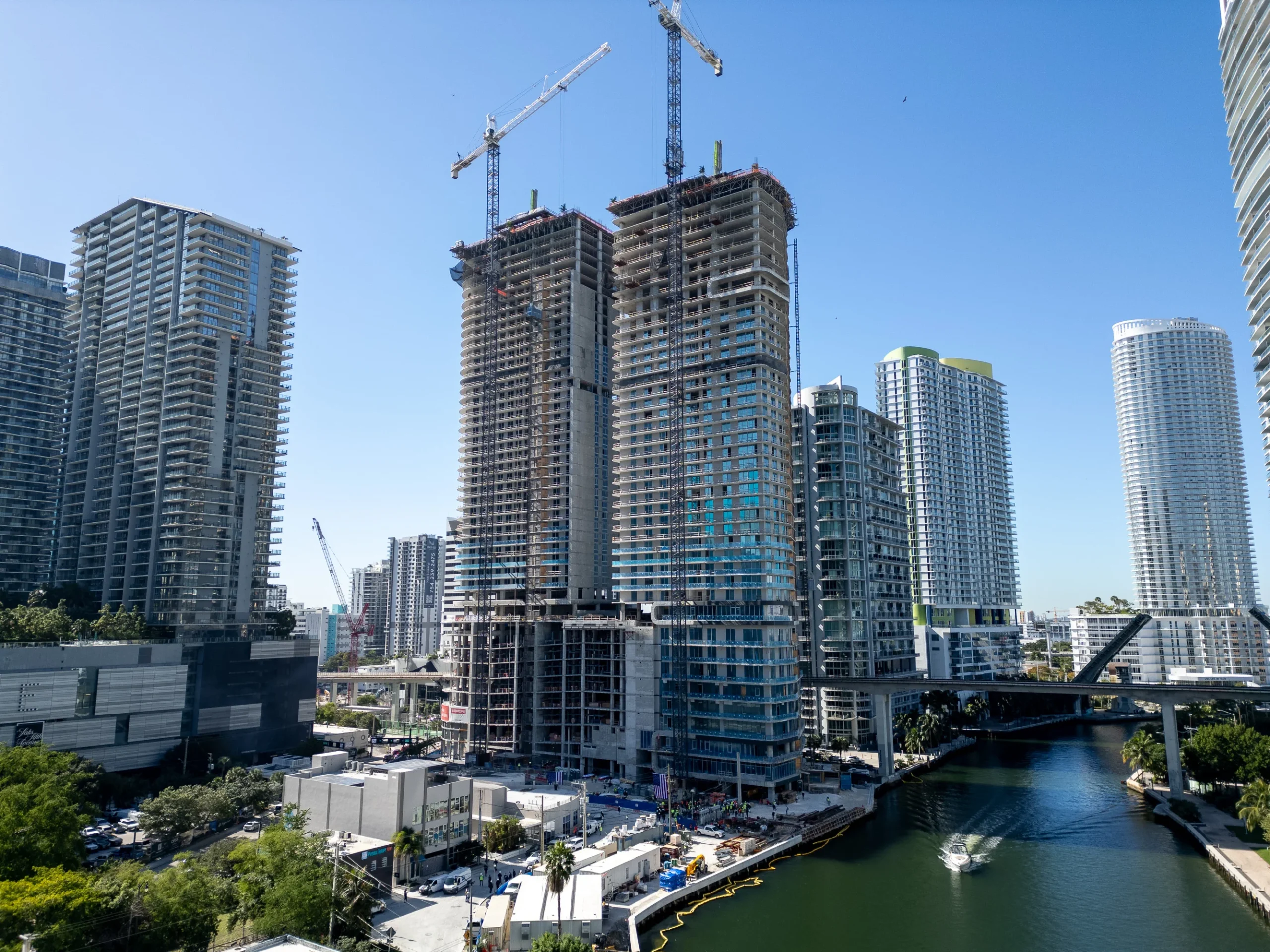
The Miami River winding through downtown Miami, with construction cranes across the skyline
Construction drone services in Miami cover more than a monthly flyover. On a South Florida high-rise, the same visit can produce progress aerials for ownership and lenders, ground camera and sound for the people doing the work, mapping for site logistics, and inspection imagery for the envelope. This page covers what that includes, how it runs on an active jobsite, and what you receive.
Why Do Construction Teams Use Drones?
Drones give a project team a consistent, timestamped view of the whole site without anyone climbing anything. On a South Florida high-rise that means schedule evidence for ownership and lenders, early sight of problems while they are still cheap to fix, roof and facade conditions reviewed without exposing crews, and marketing imagery the sales team can use.
Modern construction sites generate massive complexity. Drone mapping and progress monitoring simplify oversight, giving you real visibility into the whole site without walking it.
Stay on schedule
Monitor work weekly or biweekly from identical vantage points, so two visits are actually comparable.
Reduce rework
Catch issues early by overlaying as-built imagery with your CAD or BIM model instead of finding them at close-in.
Improve safety
Inspect roofs, facades, and tall structures without putting a crew on a lift, a swing stage, or a roof edge.
Prove progress
Give owners, lenders, and stakeholders timestamped documentation they can rely on for a draw or a board meeting.
What We Fly
What Drone Services Does the Construction Industry Actually Use?
Four, in practice. Progress monitoring on a repeatable flight path, surveying and mapping for planning and coordination, volume measurement for stockpiles and earthwork, and inspection imagery for roofs and facades. Drone Permission covers all four with one team on the same visit, so the mapping work and the camera work are not two separate mobilizations on your schedule.

Progress monitoring
Keep every stakeholder aligned with scheduled aerial updates. The same flight path and the same altitudes every visit, so the set reads as a sequence rather than a folder of nice photos. More on construction progress monitoring.
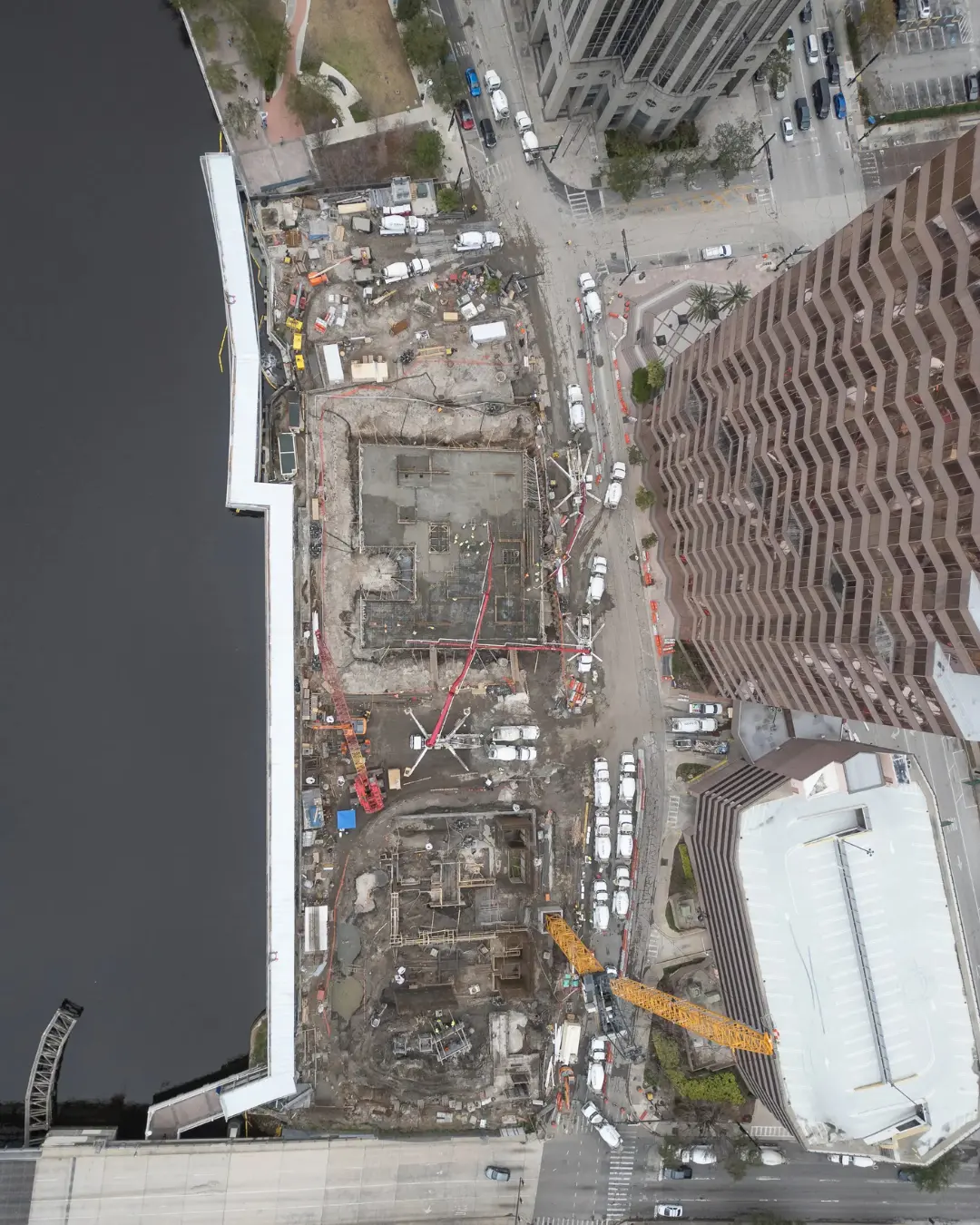
Surveying and mapping
Topographic maps, orthomosaics, DSMs, and contour lines for earthworks, grading, and design validation, at ground sampling distances as fine as 2 to 5 cm per pixel when ground control points are used. See our drone mapping services.
Volume measurements
Stockpiles, aggregates, and cut and fill volumes measured from the same capture. Automated reports give quick material estimates for billing, logistics, or resource planning.
Inspections
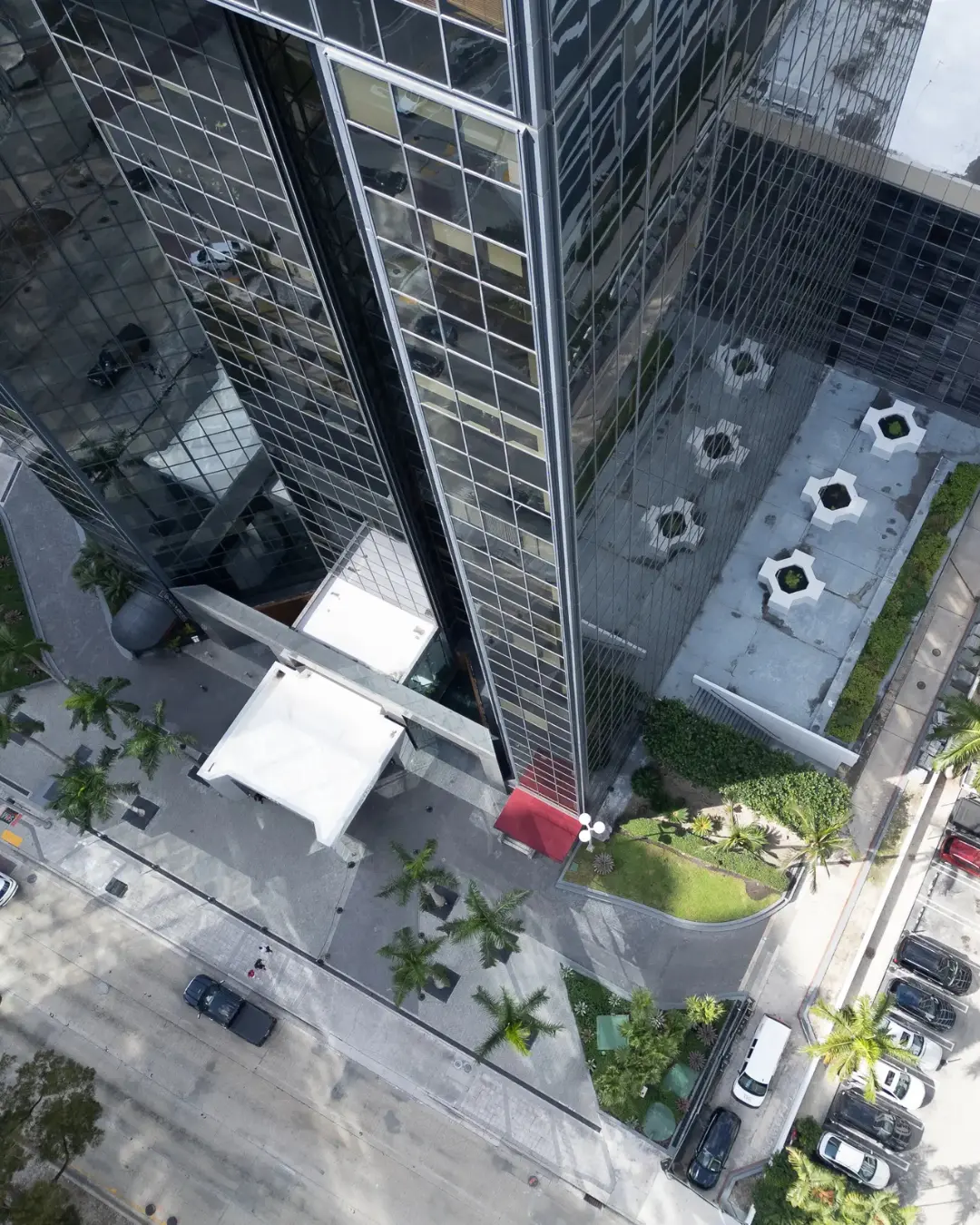
Structural and maintenance conditions found early using zoom and oblique imagery, on facades, roofs, and hard to reach infrastructure, with no scaffolding. See drone building inspections in Miami.
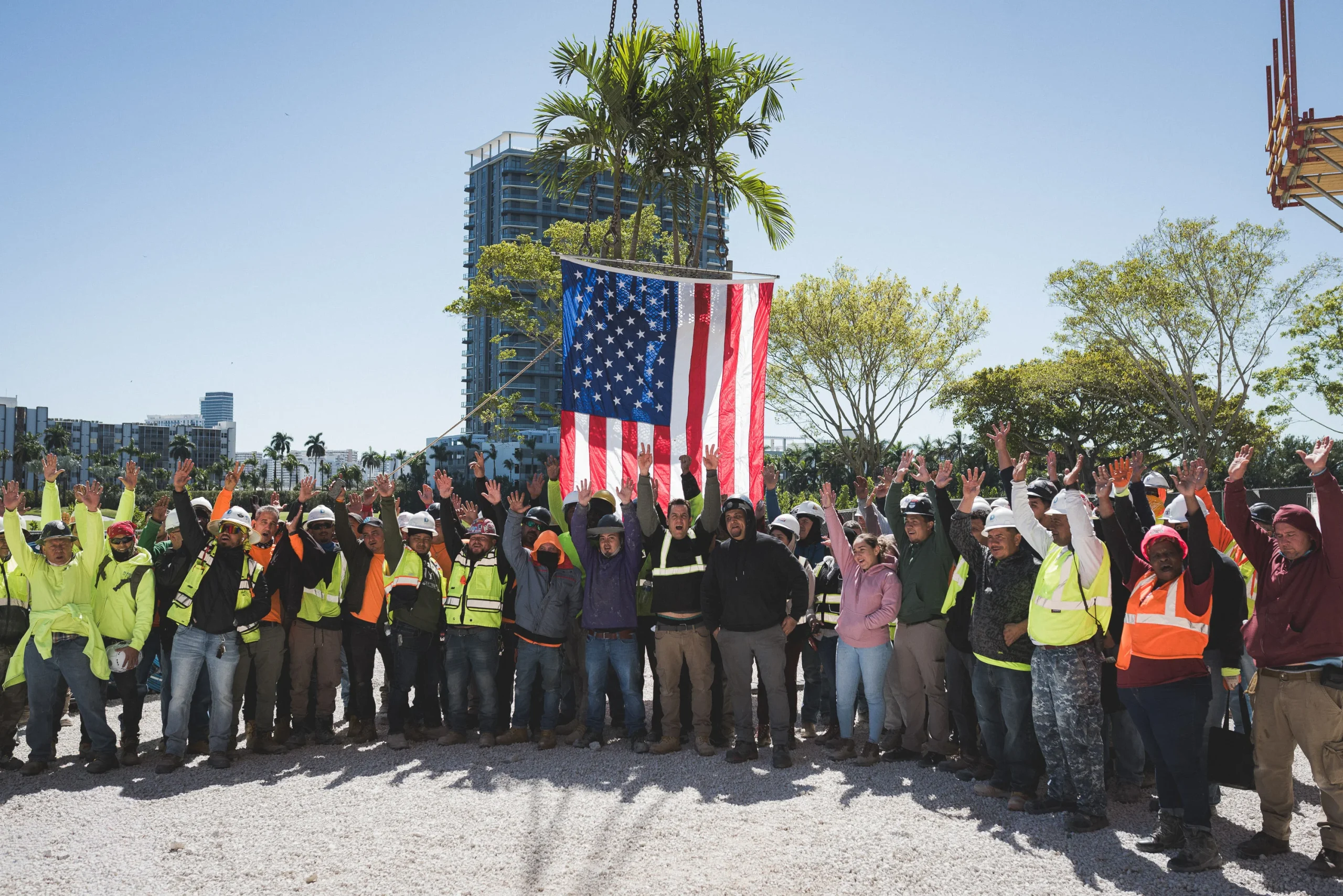
The same team also covers the dates that happen once. A mat pour, a topping out, structural completion, and handover are documented on the same footing as a monthly progress flight, with air, ground, and sound on a single visit. See topping out ceremony photography and video and foundation pour documentation.
South Florida Projects
Construction Projects We Have Documented
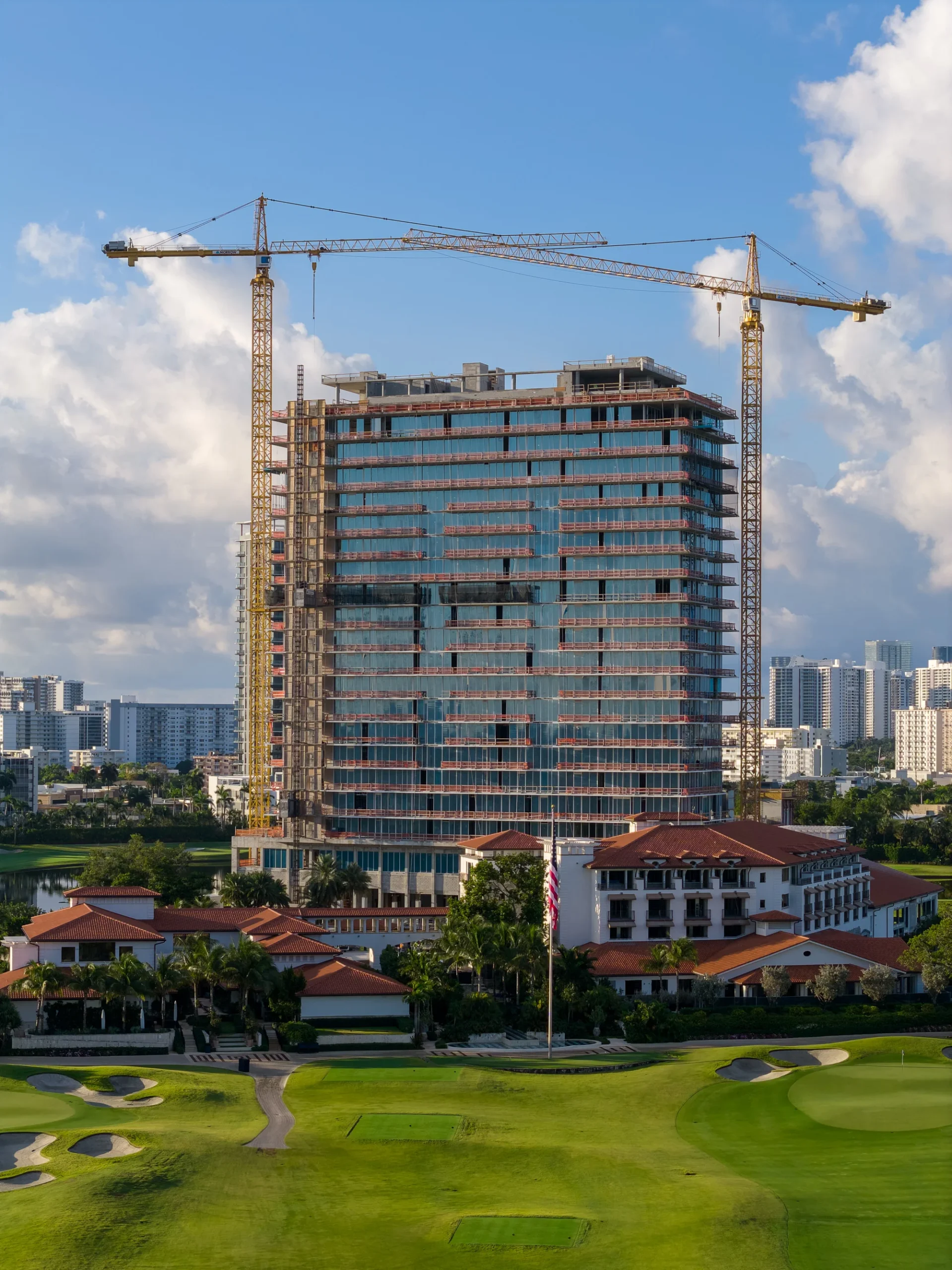
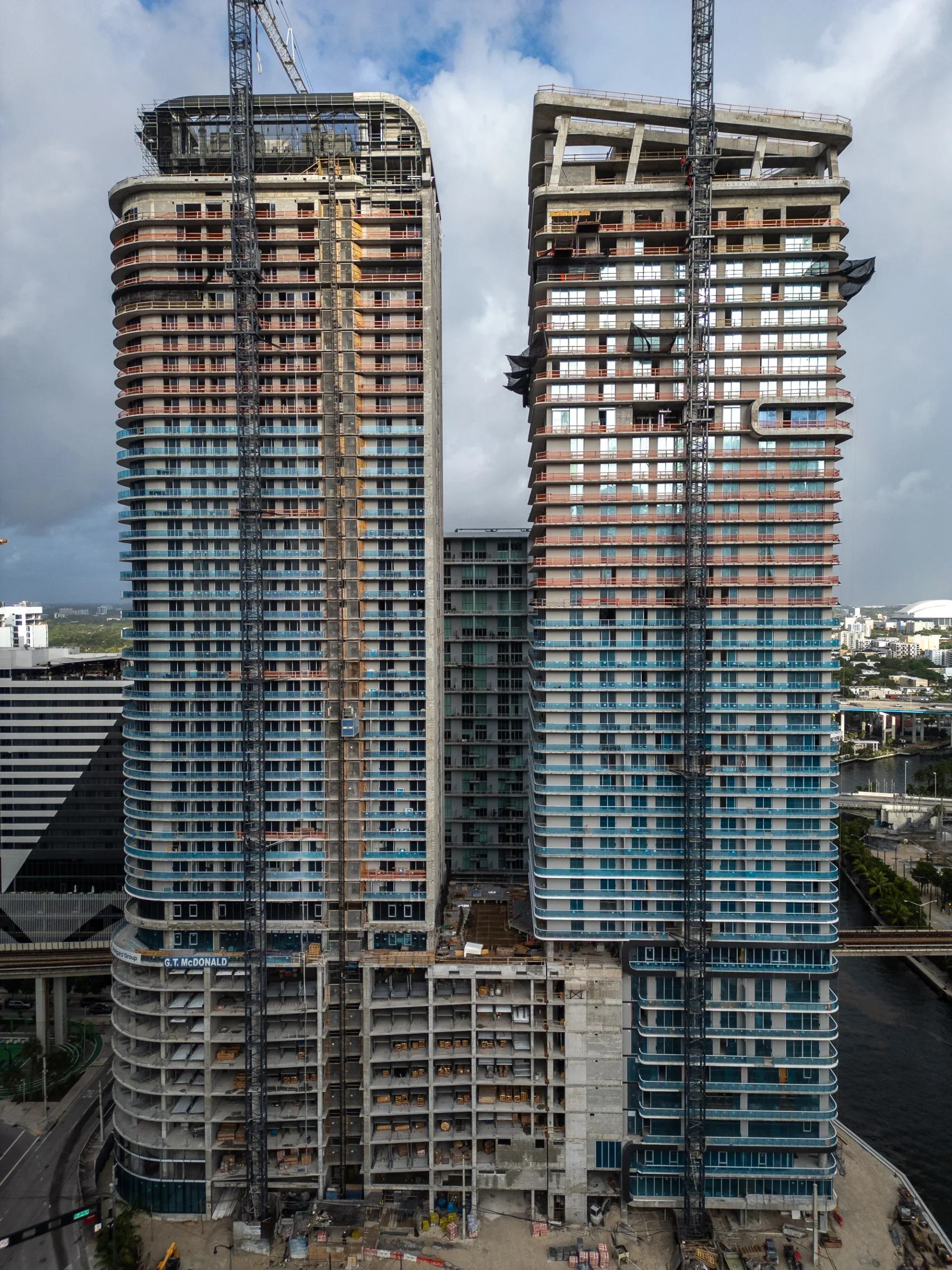
High-rise work across Miami-Dade and Broward, from foundation rebar to topping out. Click any image to enlarge.
See also: aerial photography services
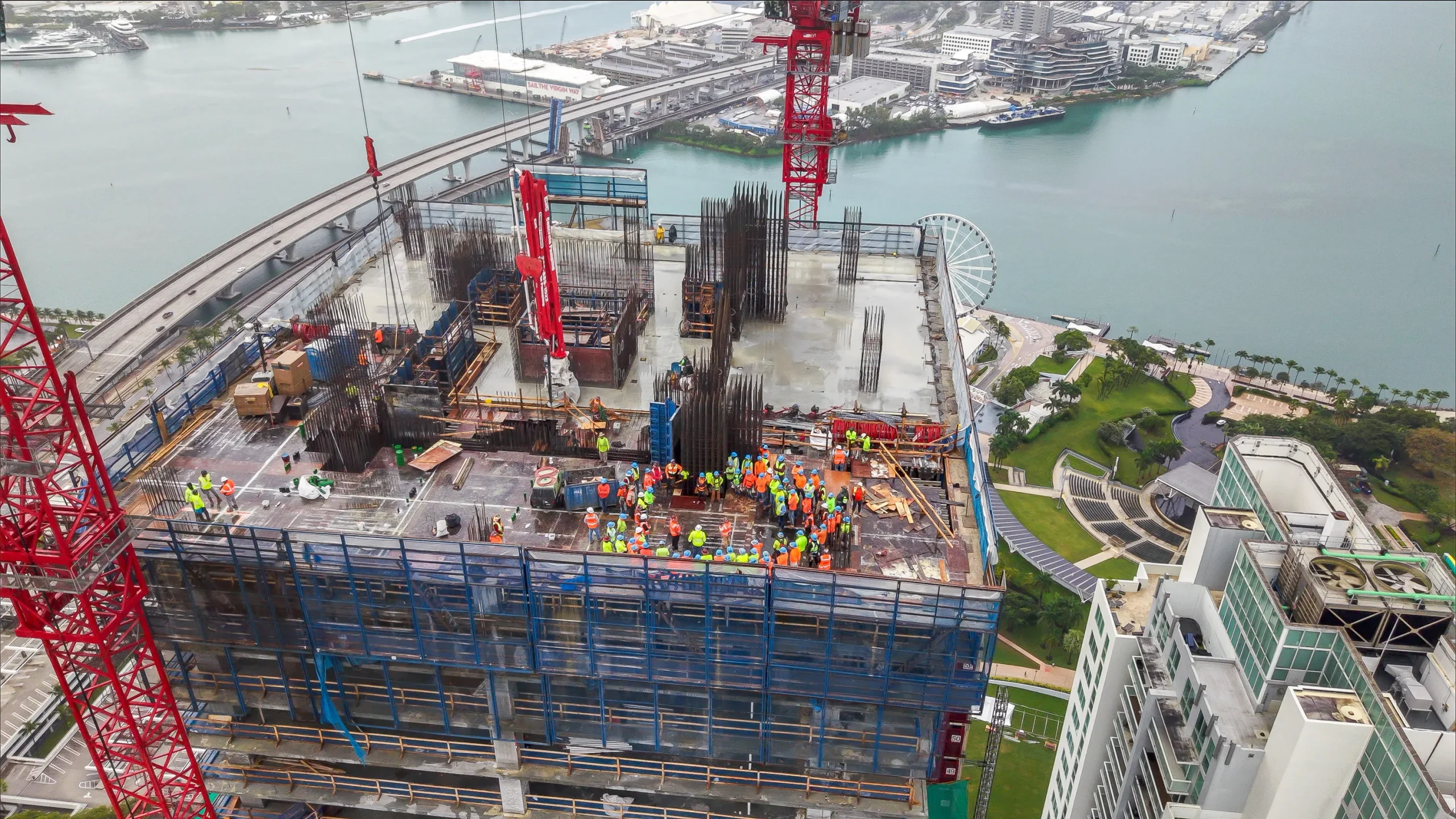

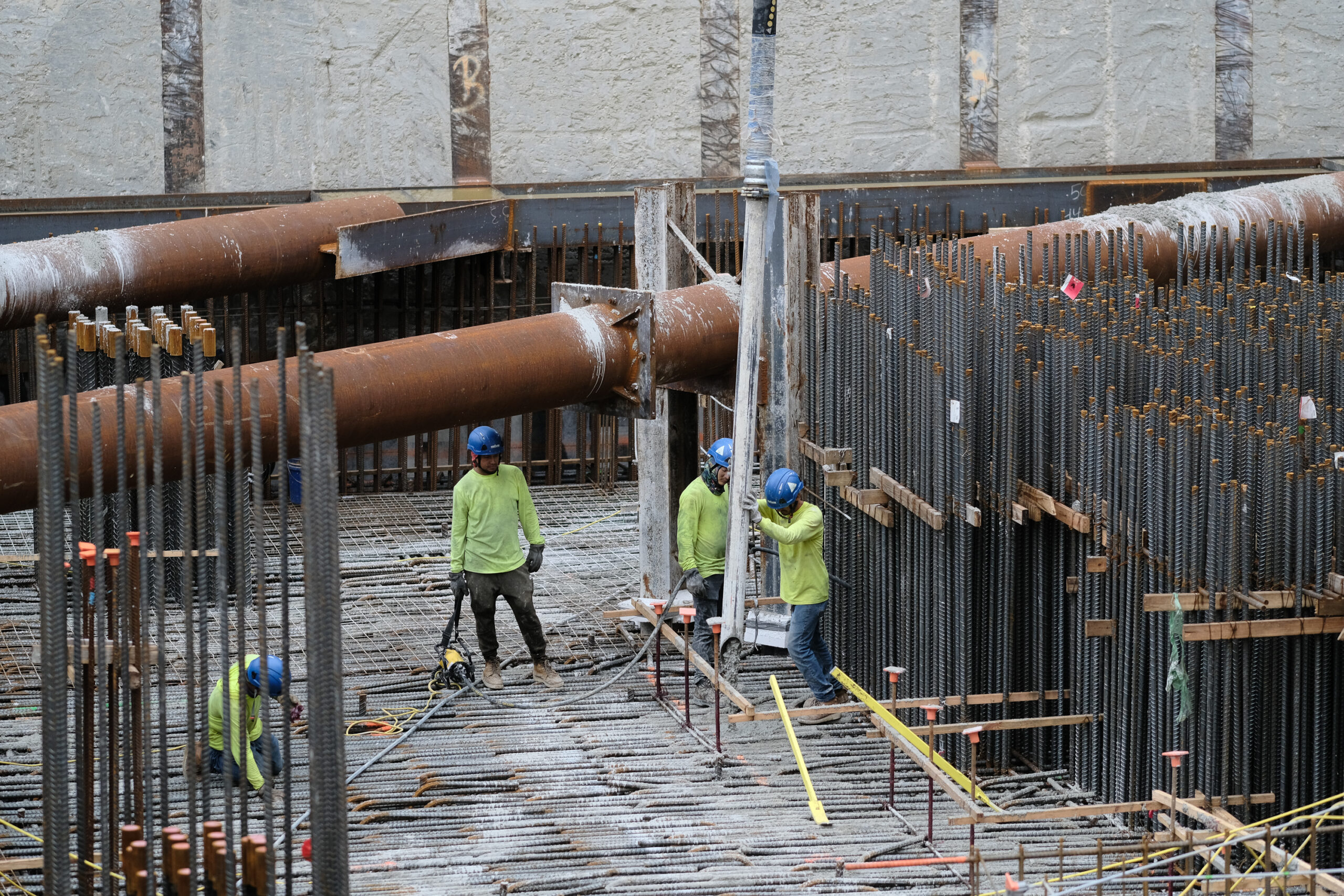
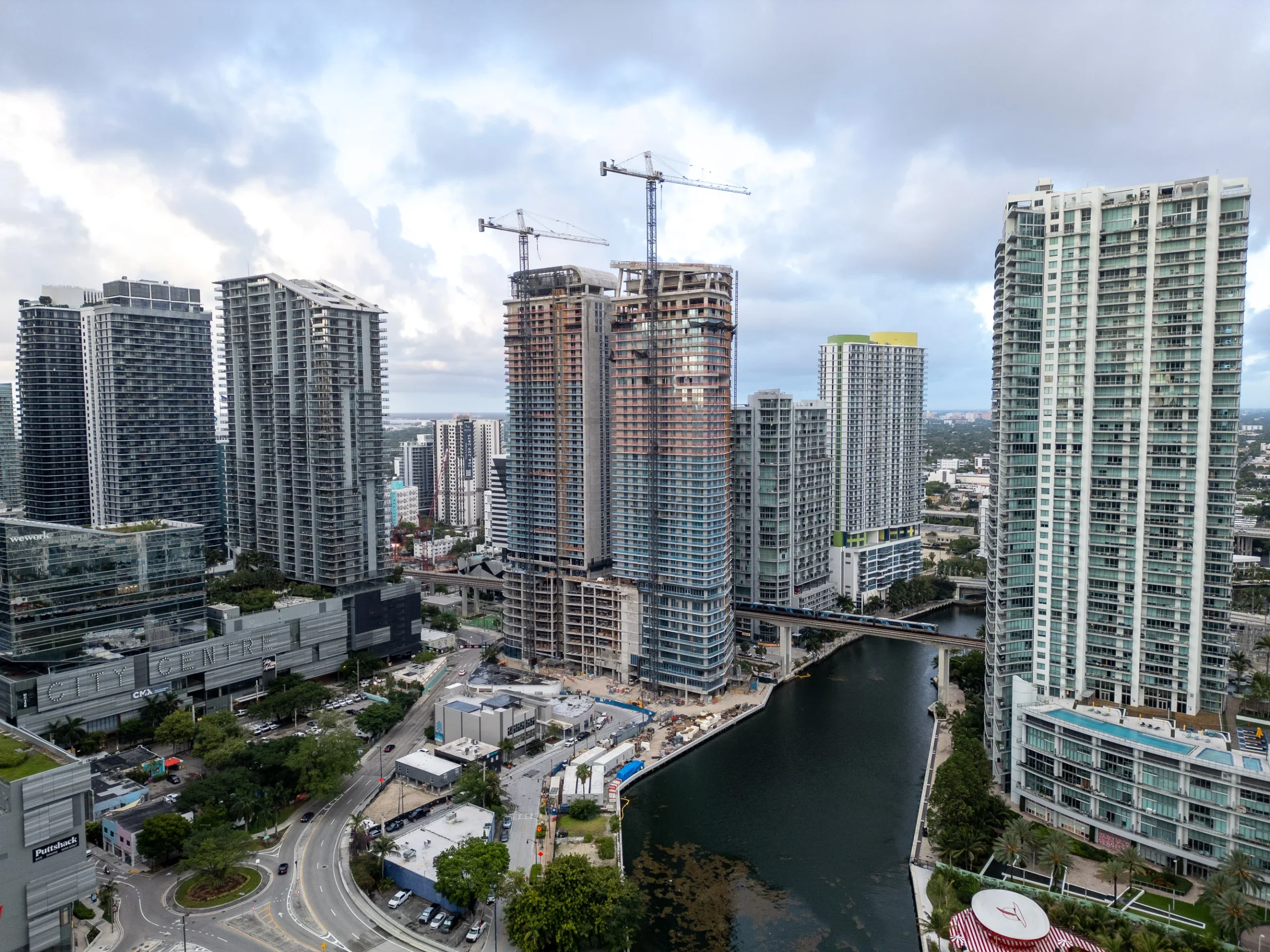
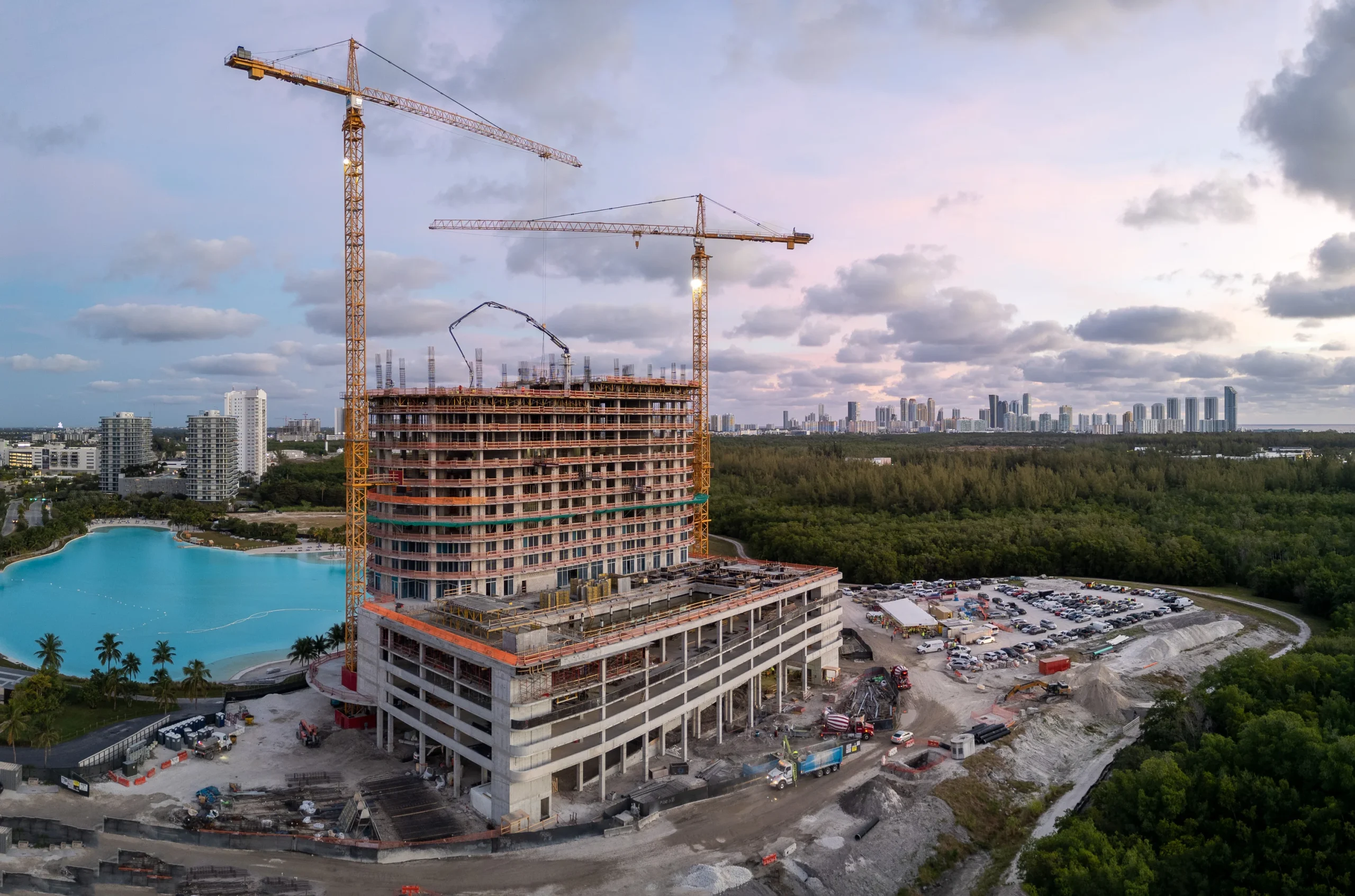
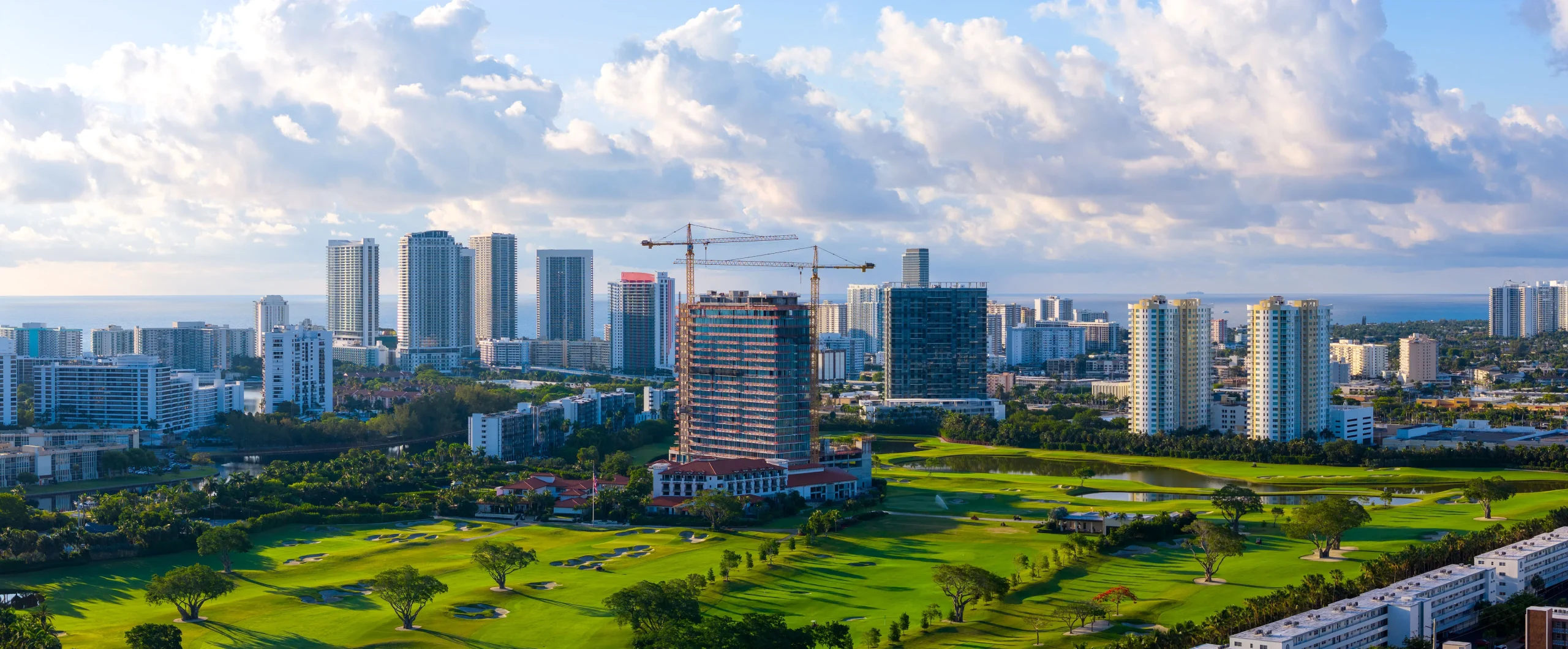
What Does Complete Construction Coverage Include?
Complete construction drone services on a South Florida project usually combine four capture methods on the same visit: aerial stills and video for scale and progress, ground camera for the work and the people, mapping for planning and coordination, and inspection imagery for the envelope. The table below shows what each one captures and where it earns its place.
| Method | What It Captures | Best For |
|---|---|---|
| Aerial photo and video | Tower elevation, site context, crane and deck activity, sunrise and dusk exteriors | Monthly progress records, marketing, press, leasing and sales material |
| Ground camera and audio | Crews at work, formwork and rebar detail, on camera interviews with clean sound | Ceremony films, recruitment, safety and quality storytelling, client handover videos |
| Drone mapping | Orthomosaics, 360 site panoramas, view studies and render overlay reference | Logistics planning, stakeholder coordination, architect view studies |
| Inspection imagery | High resolution facade, roof and envelope frames from positions no lift reaches | Envelope reviews, punch documentation, insurance and condition records |
Pricing varies by scope and frequency. We publish real ranges rather than making you ask: see drone services cost in Florida and drone mapping cost in Florida.
What Do You Receive After the Flight?
Every mission ends in a standardized package your team can open without special software: an orthomosaic, a 3D model, a point cloud, contour files, a volume report, an organized photo set with location data, and a web viewer link to share. Formats are chosen so the files drop into the CAD, GIS and BIM tools your project already runs on.
| Deliverable | Format | What Your Team Does With It |
|---|---|---|
| Orthomosaic | GeoTIFF | Georeferenced high resolution site map for planning and coordination |
| 3D model | OBJ or FBX | Visualize and review site conditions in three dimensions |
| Point cloud | LAS or LAZ | Spatial data for CAD and BIM integration |
| Contour files | DXF | Overlay reference for engineering design |
| Volume report | CSV or PDF | Quantified material estimates for billing, logistics, and planning |
| Photo set | JPEG | Organized imagery with EXIF and GPS data, ready for the project record |
| Web viewer link | Secure cloud link | Share the whole package with your team, ownership, and consultants |
One limit, stated plainly
These deliverables are documentation and planning tools. Drone mapping produces accurate, repeatable imagery, and it is the right input for logistics, coordination, quantity tracking, and design review. Measurements relied on for legal, boundary, or engineering purposes require a Florida licensed surveyor, and we will say so rather than let a deliverable be used for something it was not made for.
How Does a Construction Drone Mission Get Scheduled?
Three steps. You send the site boundary or the address, the accuracy you need and the schedule, and we come back with the right scope. Our FAA Part 107 pilot flies the approved plan and the imagery is reviewed before anything leaves our office. You receive the deliverables through a secure cloud link, usually inside two to five business days.
1. Scope and quote
Share your site boundary as a KML, a shapefile, or just an address, plus the accuracy you need and the schedule. We recommend the right package instead of selling you the biggest one.
2. Flight and QC
An FAA Part 107 certified pilot executes the mission on a pre-approved flight plan. Every frame is reviewed for quality and coverage before processing starts.
3. Delivery
Deliverables arrive through a secure cloud link, typically within two to five business days depending on the scale of the site.
The part that decides whether the set is worth anything a year from now is the repeat. We fly fixed points at the same altitudes and the same angles on every visit, so this month lines up against last month and a problem shows up as a change rather than as something somebody happens to notice. A folder of unrelated photographs does not do that, however good each photograph is.
See also: drone services in Miami
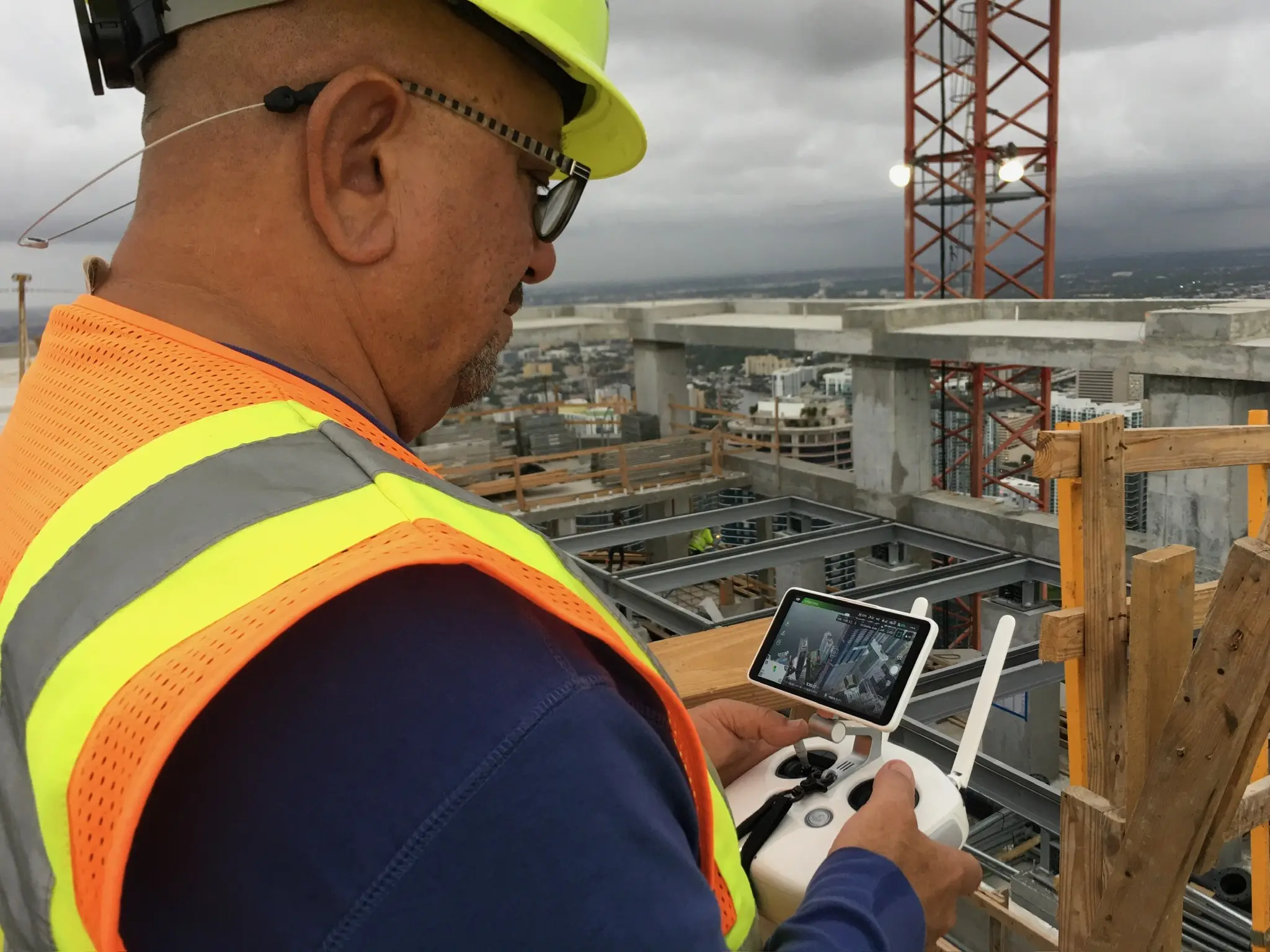
Drone Inspection or Traditional Access: Which Does the Job?
Traditional access still wins whenever somebody has to touch the building: a hammer sounding, a moisture reading, a core sample, a repair. It loses on everything visual. A swing stage takes days to permit and rig, a lift needs ground and often a lane closure, and a roof walk puts a person on a live edge. The drone does the looking.
| Traditional method | The friction | What the flight does instead |
|---|---|---|
| Swing stage or suspended scaffold | Rigging, permits, engineering sign off, and days of lead time before anyone sees anything | Same elevation, same detail, flown the same morning you call it in |
| Boom lift or man lift | Needs stable ground, clearance, and sometimes a street closure. Limited reach on a tall tower | No ground footprint, no reach limit within legal altitude, no lane closure |
| Roof and parapet walk | Fall exposure at exactly the condition you are trying to inspect | The camera goes over the edge instead of a person |
| Ground level photography | Foreshortened, blocked by fencing and staging, and the roof is invisible | Plan view and elevation view of the entire site in one visit |
| Full walking survey with a camera | A day or more of somebody's time, and the photos rarely repeat from visit to visit | A repeatable mission that produces a comparable set every time |
| Hands on testing and sampling | Slow and disruptive, and there is no alternative | Nothing. This is what the drone does not replace, and we will say so |
A camera that can hold position forty feet off a parapet at the fortieth floor sees the sealant line, the flashing, the spalling, and the staged material better than a person leaning over a guardrail, and it gets there in minutes instead of after a swing stage permit. That is the whole case for drone inspections in construction on a Miami tower. The judgment still belongs to your superintendent or your engineer. The climb is what goes away.
See also: Miami drone mapping
How Do Construction Drone Services Work on an Active Jobsite?
Working on an active construction site requires more than knowing how to fly a drone. Our team arrives prepared for the jobsite, coordinates with site leadership, follows project safety requirements, and handles FAA airspace authorization in advance, so our work fits your schedule, not the other way around.
We know construction
Hard hat, vest, boots, and glasses as standard. We understand crane operations, exclusion zones, and why nobody is walking under a pick.
We clear the airspace
Most of Miami-Dade sits under controlled airspace. LAANC authorization is filed before the date, not improvised on site.
The super sets the pace
Shot list agreed in advance and staged around the pour, the lift, or the ceremony so the day keeps moving.
Everyone gets credited
Developer, general contractor, and trade partners all get recognized in the final cut, which is usually why the video travels.
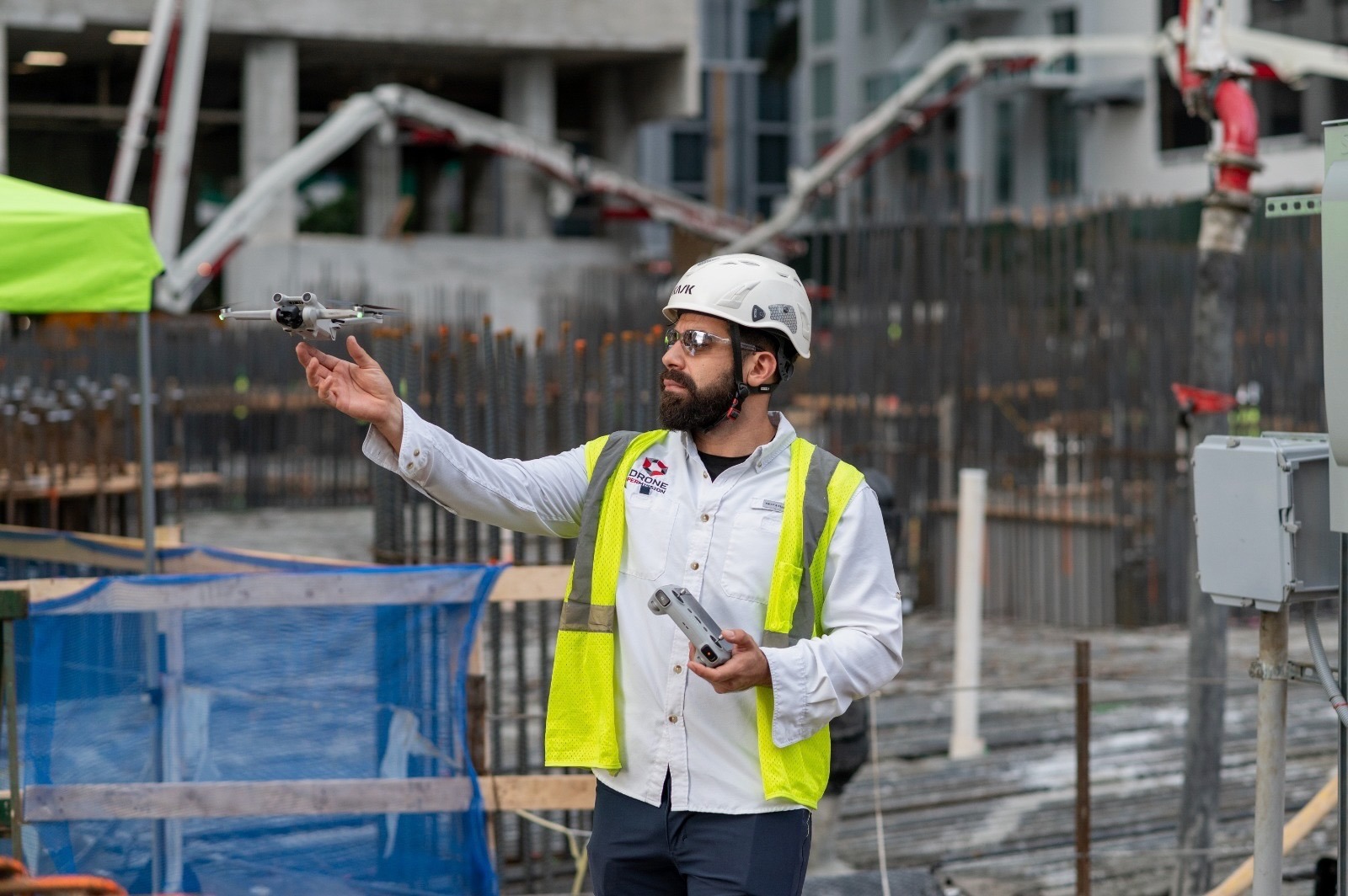
Do You Need a Permit to Fly a Drone Over a Miami Jobsite?
You do not need a permit to have a drone flown over your own jobsite, but the pilot does need credentials. Commercial flights require an FAA Part 107 certificated remote pilot and a Remote ID equipped aircraft. Most of Miami-Dade sits under controlled airspace from Miami International, Opa-locka, and Miami Executive, so the flight also needs LAANC authorization.
LAANC is the FAA system that grants near real time authorization to fly in controlled airspace, up to a published ceiling that changes grid square by grid square. Downtown, Brickell, and the areas near the airports carry low ceilings, and a request above the published grid altitude is not automatic. It goes to further coordination and it takes time. This is the single most common reason a jobsite shoot gets rescheduled at the last minute, and it is entirely avoidable by asking early.
What Part 107 allows
A 400 foot altitude limit, with an allowance to fly within 400 feet of a structure, minimum flight visibility of three statute miles, and the requirement to keep the aircraft in sight. Flights over people and moving vehicles are restricted, which is a real consideration on a site with an active crew and a public sidewalk on two sides. We plan around all of it before the date.
What Florida law adds
Statute 934.50 makes it unlawful to use a drone with an imaging device to record privately owned property or its occupants with the intent to conduct surveillance where there is a reasonable expectation of privacy. Documenting the site you control is not surveillance. Pointing a long lens into the neighboring tower's balconies is a different matter, and we plan flight paths so it does not happen.
Why Do Construction Teams in South Florida Choose Drone Permission?
Because one team covers the whole job. Air, ground, sound and editing come from the same company, the pilots are FAA Part 107 licensed and insured with a certificate of insurance on request, airspace authorization is handled before the date, and delivery runs on a schedule your project can plan around rather than an open ended promise.
Certified expertise
FAA Part 107 licensed, insured pilots across the country.
One team, everything
Air, ground, sound, and editing in house. Nothing gets handed between vendors and nothing falls between them.
Fast turnaround
Two to five business day delivery on most missions, because a milestone is only news for so long.
Accuracy you can trust
Ground control integration where the project calls for it, and an honest answer about what the data is good for.
Safety first
We manage airspace authorization and work inside your site safety plan, not alongside it.
Secure delivery
Encrypted cloud links and access controlled sharing, so the project record stays with the people who should have it.
Who Do We Work With?
General contractors, developers and owners, civil engineering firms, EPC and infrastructure teams, utilities and energy projects, and logistics parks and industrial facilities. The work looks different for each of them. A developer wants leasing imagery and a lender record, a superintendent wants last week compared with this week, and an engineer wants the envelope at a range they can actually read.
- General contractors
- Developers and owners
- Civil engineering firms
- EPC and infrastructure
- Utilities and energy projects
- Logistics parks and industrial facilities
Construction Drone Services FAQ
How much do construction drone services cost in Miami?
Cost depends on scope, site access, how often you need coverage, and whether the visit includes ground camera and interviews as well as aerial work. A single milestone visit and a twelve month progress program are priced very differently. We publish real ranges rather than hiding them behind a form, so start with our Florida drone services cost guide and our drone mapping cost guide, then send us the project and we will quote the actual scope.
Do you need FAA authorization to fly a drone over a Miami jobsite?
In most of Miami-Dade, yes. The county sits largely under controlled airspace around Miami International, Opa-locka, and other fields, and commercial operations there need air traffic control authorization. We request it through LAANC, the FAA system that returns near real time authorization for approved altitudes, and we file it ahead of the shoot date rather than on site. Some locations sit above the LAANC grid ceiling and need further coordination, which we handle before we commit to a date.
Are your pilots licensed and insured?
Yes. Every flight is operated by a pilot holding an FAA Part 107 Remote Pilot Certificate, and we carry commercial unmanned aircraft liability insurance. We can provide a certificate of insurance, and we can name your company as additional insured on request. Send the requirement with your project details and we will have the paperwork back before the site visit.
Can you fly over an active jobsite while crews are working?
Yes, and that is most of what we do. Flight over people is governed by FAA rules and depends on the aircraft category and the situation, so the practical answer on a live site is that we plan the flight path with the superintendent, stage around active picks and pours, and keep the aircraft off the crews. We work in PPE, sign in through your process, and brief before anything leaves the ground.
How often should a construction project be documented from the air?
Monthly is the most common cadence on a high-rise, because it produces a comparable record for ownership, lenders, and marketing without adding much cost per visit. Milestones sit on top of that: the mat pour, topping out, envelope close-in, and handover. Projects that need dispute or delay documentation often move to every two weeks. We would rather scope this around your schedule than sell a fixed package that does not fit it.
What is the difference between drone photography and drone mapping?
Photography produces images made to be looked at: elevation, progress, marketing, and press. Mapping produces images made to be measured against, such as orthomosaics and site panoramas used for logistics planning, coordination, and view studies. Important limit: our mapping deliverables are documentation and planning tools. Measurements for legal, boundary, or engineering purposes require a Florida licensed surveyor, and we will say so rather than let a deliverable be used for something it was not made for.
How accurate are drone measurements on a construction site?
With ground control points, expect roughly 2 to 4 cm horizontal and 3 to 6 cm vertical accuracy. That is accurate enough for progress tracking, stockpile volumes, cut and fill checks, and quantity verification. It is not a boundary or topographic survey. Anything headed for a legal, boundary, or engineering use needs a Florida licensed surveyor, and we work alongside one rather than around one.
Can a drone inspection satisfy Florida's milestone inspection requirement?
No. Florida Statute 553.899 requires a licensed architect or engineer authorized to practice in the state to perform the milestone inspection, and phase one is a visual examination of the building's structural components. A drone does not replace that professional. What it does is give the engineer high resolution, dated imagery of roofs, parapets, and upper floor conditions without a swing stage, which usually shortens the access portion of the job considerably.
Does work have to stop while the drone is flying?
In most cases no. The pilot signs in, briefs with the superintendent, and sets a launch and recovery point clear of the crane radius and the delivery route. Part 107 restricts flight over people and moving vehicles, so the flight path is planned around where the crew is working rather than the crew being planned around the flight. Brief pauses are occasionally worth it for a specific shot, and that is always agreed in advance, never assumed.
Is it legal to record a construction site and the surrounding property from the air in Florida?
Documenting the site you own or control is legal. Florida Statute 934.50 makes it unlawful to use a drone with an imaging device to record privately owned property or its occupants with the intent to conduct surveillance where there is a reasonable expectation of privacy. That is aimed at surveillance, not at construction documentation. We plan flight paths and camera angles so neighboring balconies, windows, and private outdoor space stay out of frame.
Can we integrate the data with AutoCAD, Revit, or our BIM platform?
Yes. Deliverables are produced in formats built for that: GeoTIFF orthomosaics, LAS or LAZ point clouds, DXF contours, and OBJ or FBX models. They import into CAD, GIS, and BIM platforms without conversion work on your side. Tell us which platform your project runs on before the flight and we will match the output to it rather than hand you something your team has to rebuild.
What happens if weather delays a flight?
We reschedule at no cost. South Florida weather moves fast and a marginal window produces imagery nobody wants in a project record, so we would rather move the date than deliver a compromised set. For a fixed milestone such as a pour or a ceremony we build the contingency into the plan in advance with your superintendent, because that date does not move.
What areas of Florida do you cover?
Our base and the majority of our work is Miami-Dade and Broward, including Miami, Miami Beach, Brickell, Downtown, Coral Gables, Hallandale Beach, and Fort Lauderdale. We travel statewide for projects that need it, and we have worked as far south as Key West. If your site is outside South Florida, tell us the location and the dates and we will tell you honestly whether travel makes sense for the scope.
What do you deliver, and how do we receive it?
Edited stills and video, color corrected and delivered in the format your team prefers, whether that is full resolution files for print and press or web sized versions for social and leasing. Post production, color correction, and graphics are included rather than quoted separately. If something in the delivery does not match what we agreed, we revise it.
Tell Us the Project and the Schedule
Send the site, the milestones you care about, and how often you want coverage. We will come back with a scope, a real range, and the airspace answer for that address. FAA Part 107 licensed and insured, on South Florida jobsites every week, with one team covering air, ground, sound, and editing.
Or call 305-878-9689
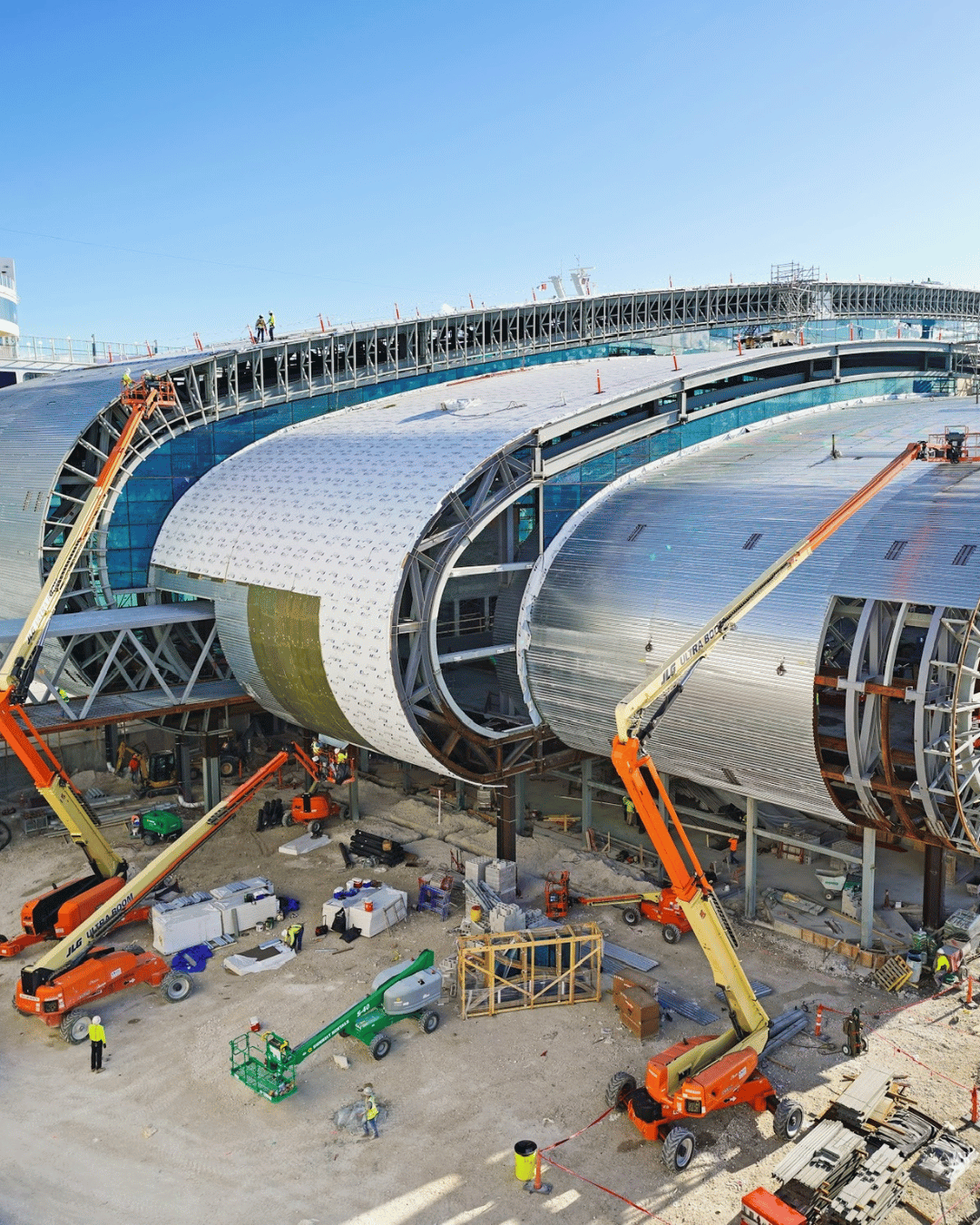
City of Miami Administration Building under construction in Little Havana