Miami · FAA Part 107 Licensed & Insured
Drone Roof Inspections: How They Work, When They Are Worth It, and What You Get Back
A drone roof inspection is a scheduled flight that photographs every square foot of a roof from directly overhead and at an angle, without anyone stepping onto the membrane. For a commercial building or a condominium, the value is not the flight. It is the dated, organized visual record you can put in front of a board, a carrier, or three competing roofers.
- 2 hoursTypical time on site for a mid-rise roof
- 0 peopleOn the roof during the flight
- Part 107Licensed and insured, LAANC ready
Ask about a roof inspection flight
Aston Martin Residences at the mouth of the Miami River, Brickell
Most of what has been written about drone roof inspections was written for the person flying the drone. Which aircraft to buy, which camera, how to start a roof inspection business. Almost none of it was written for the person who has to approve the invoice, explain the line item to a board, and do something useful with the file that comes back. This is that version. What actually happens on the day, when a drone roof inspection earns its cost and when it does not, and exactly what belongs in the report.
Key Takeaways
- A drone roof inspection produces a dated, geotagged visual record of roof condition without anyone walking the membrane, which matters most on roofs where foot traffic itself causes damage.
- It is worth paying for when you need evidence: an insurance renewal, a post storm claim, a reserve study, or three roofing bids compared on the same information.
- It is not worth paying for when you already know where the leak is, when the roof is scheduled for replacement anyway, or when the answer requires someone to physically open the roof.
- Thermal imaging shows temperature differences, not confirmed moisture, and it only works under specific conditions. Anyone selling it without saying so is selling you something.
- A drone inspection supports your engineer's work in a Florida milestone inspection or reserve study. It never replaces it, because the statute requires a licensed professional's seal.
What Is a Drone Roof Inspection?
A drone roof inspection is a planned flight that captures the roof surface in a systematic grid from directly overhead, plus angled passes along every parapet, penetration and edge condition. The output is a set of dated, geotagged, high resolution images organized by roof area, so a defect can be located again later rather than described vaguely as “near the northwest corner.”
The flight itself is the least interesting part. What separates a useful inspection from a folder of nice photographs is the organization: consistent altitude and overlap so nothing is missed, a naming convention tied to a roof plan, and enough angled detail that a roofing consultant can read a seam or a flashing condition without going up.
On an occupied building this is also a scheduling question rather than an engineering one. Nobody has to be escorted to the roof, no hatch has to be opened, and no residents have to be notified that contractors will be overhead. For a condominium board, the absence of disruption is often the easiest part of the decision to explain.

A full roof captured from directly overhead. Mechanical units, penetrations, drains and parapet edges all read in a single frame. Wyndham Grand · Clearwater Beach
How Does a Drone Roof Inspection Actually Run?
Four stages, usually inside one morning. Airspace and access get cleared before the date, the flight itself takes one to two hours for a mid rise roof, the images are processed and organized against a roof plan, and the report is delivered as a file your board and your roofer can both open. Nobody goes onto the roof at any point.
1. Before the date
Airspace authorization, building access, and a short conversation about what you are actually trying to learn. A leak investigation and an insurance renewal package are different flights.
2. On site
One to two hours for a typical mid rise roof. A systematic overhead grid, then angled passes on parapets, penetrations, drains and edge conditions. Work in the building continues normally.
3. Processing
Images are culled, organized by roof area and tied to a roof plan, so every finding has a location that can be found again on the next inspection.
4. Delivery
A report you can forward. Findings, images, locations and dates, in a format a board member can open without installing anything.
![FAA Part 107 licensed drone pilot in hard hat and high visibility vest launching from roof level over the Florida coast, [CITY], by Drone Permission](https://www.dronepermission.com/wp-content/uploads/2025/03/IMG_8265.webp)
Hard hat and high visibility vest, launching from parapet level. The crew works to the same site rules as every other trade on the building.
Miami adds one step that most of the country does not have. Almost all of Miami Dade sits inside controlled airspace, so the flight needs authorization before the date rather than on the morning of. Our pilots handle that as part of scheduling. The airspace detail is covered on our page about drone inspections in construction.
When Is a Drone Roof Inspection Worth Paying For?
When you need evidence rather than an opinion. The four situations that consistently justify the cost are an insurance renewal or claim, a post storm assessment against a known baseline, supporting documentation for a reserve study, and comparing competing roofing bids against one independent record instead of each contractor's own photographs.
Insurance renewal and claims
Carriers increasingly ask for current roof condition documentation at renewal. A dated aerial set answers that request directly. After a storm, the same set flown beforehand becomes the baseline that separates new damage from pre existing wear.
Reserve studies and capital planning
A reserve professional has to estimate remaining useful life on a roof. Current, dated, comprehensive imagery is legitimate supporting evidence for that judgment, and it costs far less than the deferred maintenance it usually surfaces.
Comparing roofing bids
Three roofers will produce three sets of photographs supporting three different scopes. One independent aerial record, shared with all three, changes the conversation from whose photos to believe into what the work actually is.
Roofs you should not walk
Some membranes are damaged by foot traffic. Some parapets and edges cannot be safely reached at all. On those roofs, the alternative to a drone is not a cheaper inspection, it is no inspection.
A building still under construction is a different job with a different cadence, and that work sits under our drone services for construction.
When Is a Drone Roof Inspection the Wrong Purchase?
Three situations, and we would rather say so before you book. If you already know where the leak is, if the roof is going to be replaced regardless of what the images show, or if the question can only be answered by physically opening the roof, a flight will produce a nice looking file that does not move your decision forward.
You already know where the leak is
If maintenance has located it and a roofer is scheduled, aerial imagery adds documentation but not a decision. Buy it only if you want the record for a claim.
The roof is coming off anyway
When replacement is already funded and scheduled, condition documentation of a roof about to be removed is a cost with no decision attached to it.
The answer is under the membrane
Saturation inside the roof assembly is confirmed by core cuts and moisture meters, not by a photograph. Aerial imagery narrows where to cut. It does not replace cutting.
There is a fourth case worth naming honestly. If your roofing contractor offers a free inspection and you trust them, and you are not gathering evidence for a claim, a board vote or a bid comparison, take the free one. The reason to pay for an independent flight is independence, and if independence is not what you need, do not pay for it.
Does a Thermal Scan Tell You Where the Water Is?
Not exactly, and this is where most marketing overstates. A thermal scan (infrared imaging) shows temperature differences across the roof surface. Wet insulation holds heat and shows up as a warm anomaly, which is genuinely useful. But so does poor insulation, a mechanical penetration, or a patch of different material. Thermal tells you where to look. It does not confirm what is there.
Thermal also has conditions. The roof has to be dry on the surface, there has to be a meaningful temperature difference between the roof assembly and the air, and the wind has to be low. In practice that puts a useful thermal flight in a narrow window, and in a South Florida summer it can be a difficult window to hit. Anyone who books a thermal flight for you without discussing conditions is not being straight with you.
| What you want to know | What thermal can do | What actually confirms it |
|---|---|---|
| Is there wet insulation in the assembly | Flags warm anomalies that are candidates for saturation | Core cuts, or a capacitance or nuclear moisture meter, taken at the flagged locations |
| Where should we cut to check | Narrows a whole roof down to a handful of specific areas, which saves cores and saves money | The core itself |
| Is the membrane failing at seams and flashings | Little to nothing, this is a visual condition | High resolution angled visual imagery, or hands on inspection |
| Has damage changed since last year | Comparison against a prior scan flown under similar conditions | A prior scan actually exists, which is the part people skip |
What Goes in a Drone Roof Inspection Report?
A report a board can act on has six parts: an overview map of the roof, a numbered findings list, dated and located imagery for each finding, a severity or priority rating, a comparison against the previous inspection where one exists, and the flight metadata that makes the whole thing defensible. Photographs alone are not a report.
This is the part almost nobody publishes, and it is the part that decides whether the file is useful in eighteen months. The test is simple: can a board member who was not on the call open it, understand what is wrong, see where it is, and vote on it. Can your roofer bid from it without a second visit. Can your carrier accept it without a follow up request.
| Section of the report | What it contains | Why it matters later |
|---|---|---|
| Roof overview | A single top down map of the full roof with areas labeled | Gives every finding an address instead of a description |
| Findings list | Numbered items, each with a location reference, a short description and a priority | This is what the board actually votes on |
| Imagery per finding | Overhead and angled frames of each item, dated and geotagged | A roofer can scope from it; a carrier can file it |
| Priority rating | A consistent scale separating act now from monitor from cosmetic | Turns a list of problems into a budget conversation |
| Comparison to last inspection | Same locations, previous imagery, what changed | This is where the value compounds. The second inspection is worth more than the first |
| Flight metadata | Date, time, conditions, pilot certification, equipment | Makes the record defensible in a claim or a dispute |
Two practical notes. Ask for the raw imagery alongside the report, not just the summary, because a future engineer or roofing consultant may want to look at something nobody flagged this year. And ask how findings are located, because a report that says “blistering on the north side” is worth much less than one that says “Area C, item 7, with a photograph.”
South Florida Buildings
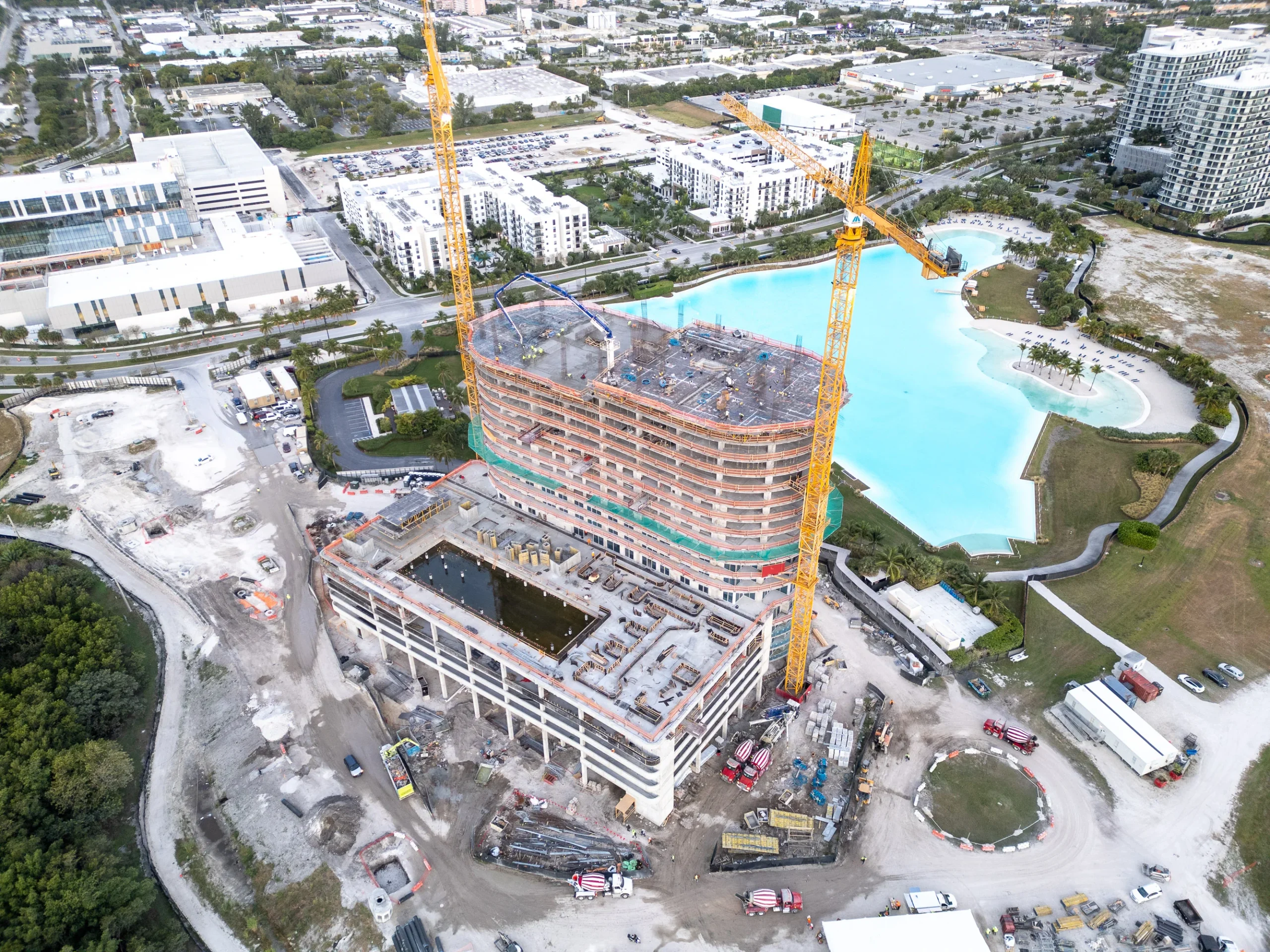
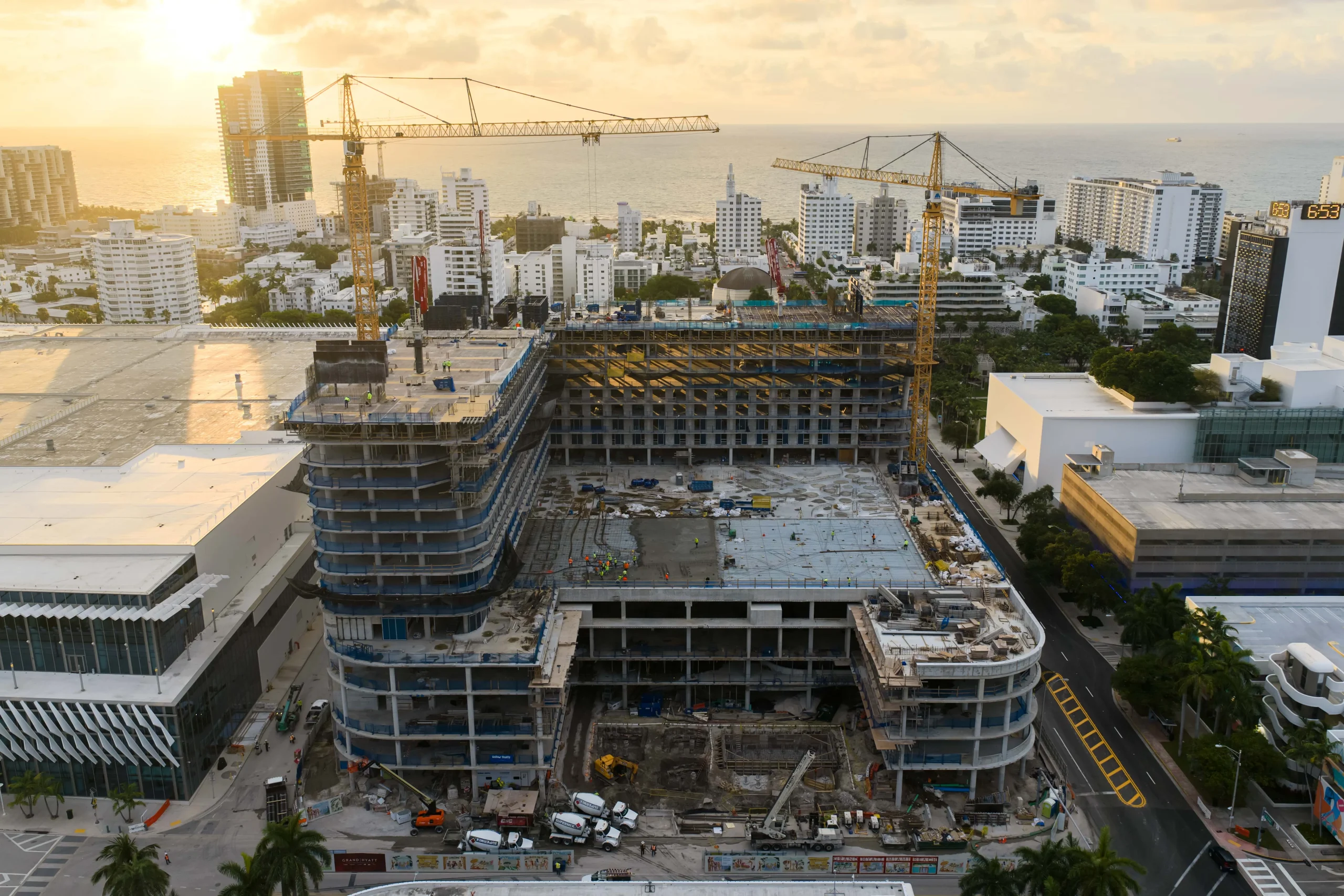
Buildings We Have Documented From the Air
These are aerial frames from South Florida projects rather than roof condition surveys. Click any image to enlarge. More of this work sits under our aerial photography services.


Where Does a Drone Inspection Fit Florida's Condo Requirements?
It supports the professional, it does not replace them. Florida's milestone inspection under Statute 553.899 requires a licensed architect or engineer, and the Structural Integrity Reserve Study requires a licensed or credentialed reserve professional. A drone inspection is documentation those professionals can use inside their own work. The seal has to come from them.
We say this plainly because the ambiguity causes real problems. A board that believes it has satisfied a milestone requirement with an aerial roof survey finds out otherwise at the worst possible time, usually when the report is due.
What a drone inspection does legitimately do inside that process is give the engineer or the reserve professional current, comprehensive, dated imagery of a roof that is otherwise expensive and slow to document. It is a tool inside their work product, not a substitute for it. The full answer on milestone inspections is on our page about drone inspections in construction.
We fly buildings across Miami Dade and Broward, and the local picture is on our page about drone services in Miami.
Drone Roof Inspection FAQ
Can you actually inspect a roof with a drone?
Yes, and for many commercial and condominium roofs it is now the default first look. A drone captures the full roof surface in high resolution from overhead and at an angle, including parapets, penetrations and edge conditions that are difficult or unsafe to reach on foot. What it cannot do is inspect what is underneath the membrane, which still requires physical access.
How accurate is a drone roof inspection?
For visible surface conditions it is very good, often better than a walking inspection, because the camera sees the whole roof consistently rather than the parts a person chose to walk to. For conditions inside the roof assembly it is not an accuracy question at all, because no camera sees through a membrane. That is what core cuts and moisture meters are for.
How long does it take, and does anything in the building have to stop?
A typical mid rise roof takes one to two hours on site. Nothing in the building stops. Nobody needs roof access, no hatch is opened, and residents or tenants are not disrupted. The scheduling work happens before the date, because most of Miami Dade sits in controlled airspace and the flight needs authorization in advance.
Is a thermal scan worth adding?
Sometimes. A thermal scan shows temperature differences, which can flag wet insulation, but a warm area can also be poor insulation, a penetration or a different material. It also needs a dry roof, a real temperature difference and low wind, which is a narrow window in South Florida. It is worth adding when you are hunting for saturation and are prepared to confirm with core cuts. It is not worth adding as a default.
What do I actually receive at the end?
A report with a roof overview map, a numbered findings list with locations and priorities, dated and geotagged imagery for each finding, comparison against any previous inspection, and the flight metadata. Ask for the raw imagery as well as the report, because a future consultant may want to examine something nobody flagged this year.
Will my insurance carrier accept drone imagery?
Aerial roof imagery is widely used in Florida property insurance, including by carriers conducting their own inspections, but acceptance depends on your carrier and your policy. Ask your agent what they require before you book, so the flight can be scoped to produce it. A dated set flown before storm season is also the baseline that separates new damage from pre existing wear afterward.
Does a drone roof inspection satisfy Florida's milestone inspection or a reserve study?
No. Florida Statute 553.899 requires a milestone inspection to be performed by a licensed architect or engineer, and a Structural Integrity Reserve Study requires a licensed or credentialed reserve professional. A drone inspection produces documentation those professionals can use within their own work. It does not replace the professional or the seal.
How often should a commercial roof be inspected?
The common guidance is at least twice a year plus after any major storm, which in South Florida means before and after hurricane season at minimum. The interval matters less than the consistency. Two inspections flown the same way a year apart tell you far more than four inspections flown differently.
My roofing contractor offers this for free. Why would I pay?
If you trust them and you are not gathering evidence, take the free one. You pay for an independent inspection when the record has to be neutral: comparing competing bids, supporting an insurance claim, documenting condition for a board vote, or building a year over year history that does not belong to whoever is bidding the work.
Do you need a license to fly a drone for a roof inspection?
Yes. Any commercial drone flight in the United States requires an FAA Part 107 licensed remote pilot, and flights in controlled airspace require authorization before takeoff. Our pilots are FAA Part 107 licensed and insured and handle airspace authorization as part of scheduling. It is worth asking any vendor for both, in writing, before they fly over your building.
Your Roof Is Easier to Document Before You Need the Documentation
Tell us the building, the roof type and what the inspection is for, whether that is a renewal, a reserve study, a bid comparison or a baseline before storm season. We will tell you what the flight should look like and what the airspace over that address allows. FAA Part 107 licensed and insured, working South Florida buildings.
Ask about a roof inspection flight
Or call 305-878-9689
A selection of South Florida projects documented by Drone Permission